SEND Spying: The report that found surveillance and called it something else

An independent KC investigated four years of complaints by SEND parents that Bristol City Council had been watching them online. She found no widespread surveillance and no breach of law. In her own legal analysis, she also accepts — three times — that surveillance occurred: the council’s 8 October 2021 evidence-gathering exercise, the three-and-a-half month collection of one parent’s tweets between January and May 2022, and the May 2022 collation forwarded internally.
Across four mothers and twenty-four numbered allegations, she upholds none.
This is what the report says, the standard it applies, and what it leaves unsaid.
On 25 June, the Children and Young People Policy Committee will receive Aileen McColgan KC’s report into concerns first raised in July 2022 about Bristol City Council staff monitoring the social media accounts of SEND parents. The investigation took seven months, cost roughly £90,000, was funded from the SEND budget, and arrives at the committee “for noting”.
The headline finding, the one being briefed and most likely to be reported, is the following: no widespread or systematic surveillance of SEND families, no breach of the Regulation of Investigatory Powers Act 2000, no breach of Article 8 of the Human Rights Act.
The legal section of the same report contains something the executive summary does not. Working through the RIPA framework, McColgan accepts in three separate findings that surveillance did take place.
At paragraph 287.4, she finds that the council’s 8 October 2021 evidence-gathering exercise “amounted to or involved ‘surveillance’” within the statutory meaning of RIPA.
At paragraph 287.9, she accepts that a three-and-a-half-month collection of one parent’s tweets, conducted by a member of staff between 22 January and 3 May 2022, “may have amounted to surveillance for the purposes of RIPA”.
At paragraph 287.10 she accepts the same of the 20 May 2022 collation and internal forwarding of twelve of Parent A’s tweets. What separates these findings from the conclusion that no RIPA breach occurred is the qualifier covert — and on that point the entire weight of the report’s conclusion rests on a single argument: that surveillance of publicly available material cannot be covert.
What follows is what the report records, what it concludes, and what it leaves unsaid. None of what follows is alleged. Every item is something the investigator herself records as having happened.
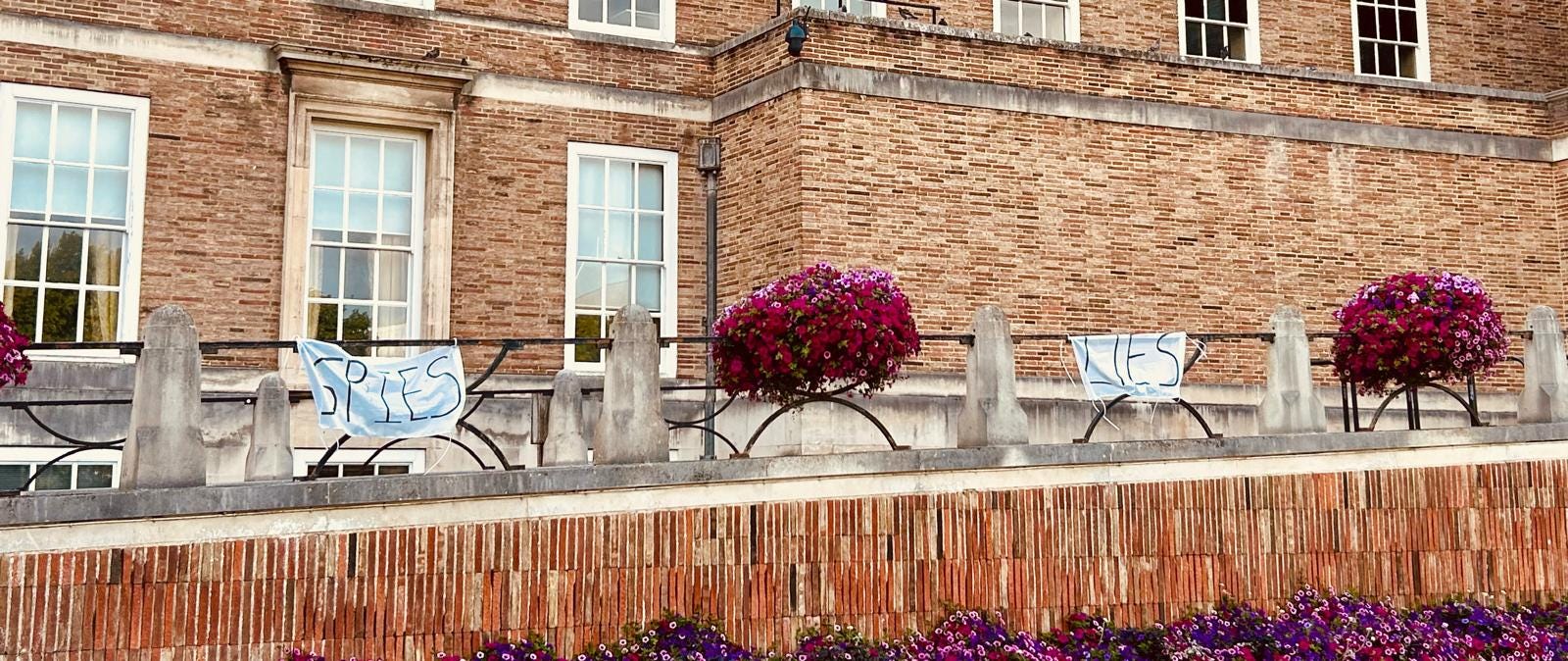
What the report acknowledges took place
Across the per-allegation findings and the legal analysis, McColgan acknowledges the following. In each case, she finds the conduct did not amount to spying, covert surveillance, or a breach of the parents’ legal rights.
A communications officer “keeping an eye” on Parent A’s Twitter account, forwarding at least five tweets over a five-week period (paragraph 21). A formal evidence-gathering exercise on 8 October 2021 in which staff collated material on Parents A and B (paragraph 23). A screenshot of one of Parent A’s tweets circulated internally with an email asking colleagues to “call her out on her behaviour” and “make a plan”, reaching the interim director (paragraph 26). A second evidence-gathering exercise across April and May 2022, in which twelve of Parent A’s tweets were collected and forwarded internally (paragraphs 27 to 28).
Ongoing monitoring of Parent A’s Twitter account, in the staff member’s own words, “got into a kind of habit, a routine because I’d been asked to collect this stuff of just dipping into Twitter when I thought about it and taking a random screenshot of whatever it was” (paragraph 29). Regular flagging of Parent A’s tweets to a particular staff member, which McColgan characterises as content-related (paragraph 30). A BCC staff member who joined Twitter in September 2021 and took an interest in Parent A’s posts, was “nothing inherently problematic” (paragraph 32).
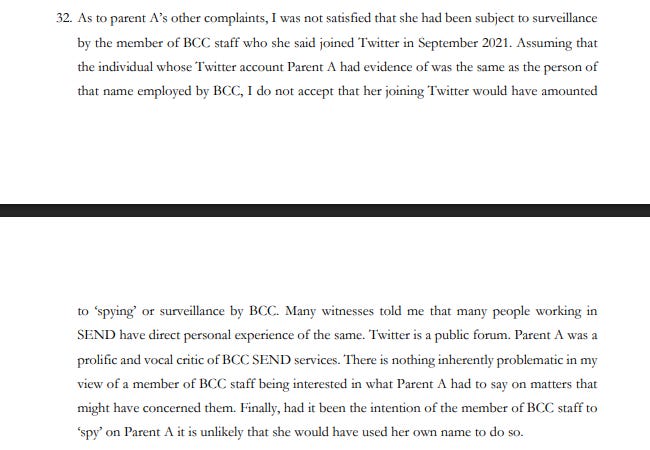
Active steps to identify whether Parent B was the person behind an anonymous Twitter account (paragraph 34), conducted in part by scrolling through approximately sixty profile photographs on her Facebook page to match a wedding bouquet image. Collation and external sharing of evidence on Parent B with Contact and the BPCF (paragraph 37). A conclusion that Parent B was the person behind the “Bristol Citizen” account, reached “on reasonable grounds, whether or not she was correct” (paragraph 40).
Three of these findings are returned to below, where the legal section’s own admission that surveillance took place is set out in full.
Twenty-four allegations. None upheld.
Parent A raised twelve numbered allegations. Parent B raised twelve numbered complaints. Parents C and D raised further concerns. Not one is upheld.
The findings against Parent A’s allegations follow a common shape. Her tweets were picked up “because of the subject matter”, not because she was being monitored. The forwarding of her posts was a reasonable response by an “enthusiastic” member of staff. The October 2021 evidence-gathering exercise could not properly be characterised as spying. The “make a plan” email did not amount to surveillance. The twelve-tweet collation did not amount to spying. The screenshot taken twenty-three minutes after posting did not amount to spying. The staff member’s “habit” of dipping into Twitter was sporadic, not surveillance. The “regularly monitored” admission was content-related, not person-targeted. The BCC staffer who joined Twitter and took an interest in Parent A’s posts was not problematic. Parent A’s claim that at least seven parent carers had been spied on was mistaken.
Parent B’s complaints follow the same shape. The Facebook search through approximately sixty profile photographs: reasonable steps. The external sharing of evidence on her with Contact: not surveillance. The conclusion that she was Bristol Citizen: reasonable, whether or not correct. The claim that her son’s services had been reduced as a consequence: “not well founded”. A staff member’s alleged comment about her Facebook group administration: not satisfied the comment was even made—this despite the verbatim notes quoted at para 133 saying: “in terms of your [] leadership of other parent groups [] we believe a conflict of interest with your role as forum chair.”
Parent C: “I did not uphold any of Parent C’s concerns.” Parent D: the same conclusion as Parent C.
The closest the report comes to a partial concession is in three places. At paragraph 29, McColgan accepts the “dipping” conduct “did indicate ongoing monitoring of Parent A’s Twitter account, albeit of a sporadic and perhaps ineffective nature” — and finds it did not amount to spying because Twitter is public. At paragraph 40, on the identification of Parent B as Bristol Citizen, she finds the staff member’s conclusion was reached “on reasonable grounds, whether or not she was correct”, leaving openly on the record the possibility that the identification was wrong. At paragraph 287.10, deep in the legal analysis, she accepts the May 2022 collation “may have involved ‘surveillance’ for the purposes of RIPA”, though not covert surveillance. None of these slight admissions changes the number of complaints upheld. Zero.
A reader who has worked through the per-allegation findings is entitled to ask what standard of evidence would have led to a complaint being upheld.
Multiple staff members described as monitoring; named-individual lists drawn up; cross-platform identification work; tweets collected, forwarded and packaged for external recipients; an internal email by a staff member describing her own conduct as “regularly monitored” and “regularly flagged”. All recorded as fact. All found to be something other than what the parents complained of.
“We are going to need to start to collate hard evidence”
The single most explicit piece of evidence in the report is an internal BCC message quoted at paragraph 118. One staff member asks another to organise a systematic collection of social media material on two named parents. The message opens by stating that the council is “going to need to start to collate hard evidence”. The sender notes she does not use Twitter herself and so can only see a few tweets at a time, but that she has been saving material personally over the past few months. What she now wants is for the recipient to ask a colleague in the Comms team to undertake the work. The request is for tweets, newsletter articles, and any other social media material going back to January that is critical of the council and of health services in relation to SEND. Two parents are named. One is also referred to under the alias “Bristol Citizen”. October is given as a starting point.
Every element the report concludes was absent is present in the message. The targets are named individuals. The collection is systematic, to be undertaken by Comms on instruction, not sporadic or content-driven. The window is retrospective, covering months across multiple platforms. The purpose is a permanent record, in the sender’s own words, of “hard evidence”. The Home Office Code of Practice that McColgan was applying says at paragraph 3.10 that RIPA authorisation should be considered where the study of an individual’s online presence becomes persistent or where material is extracted and recorded. At paragraph 3.16, it lists factors that should trigger consideration: whether the activity is directed at an individual, whether information will be recorded and stored, and whether it will be combined with other sources. The message meets every factor. No authorisation was sought. The report finds none was required.
The conclusion at paragraph 51 that staff time spent on monitoring “other than” subject-based Comms work was “minimal, probably no more than a day or two” is hard to square with a documented request for the Comms team to gather every piece of critical social media on two named parents going back months across multiple platforms.
What staff said, and what the investigator accepted
The body of the report contains a series of passages in which BCC staff describe what was happening. They are the most revealing material in the document. Almost without exception, the investigator accepts them at face value.
At paragraph 129, staff are recorded discussing the identification of a parent as the holder of an anonymous Twitter account. One says she is “just a bit worried that she could accuse us of surveillance” because “you had to really dig to find her”. Another says they don’t want to “open another can”, of worms plainly. The conduct is then justified: the parent had been “commenting on very negative things very regularly” and “showed us her colours”. The final line is operational: “OK. I’ll put it all together for [redacted] and they can decide what they share.” Staff knew, in the moment, that what they were doing could be characterised as surveillance. They worried it could be. They proceeded.
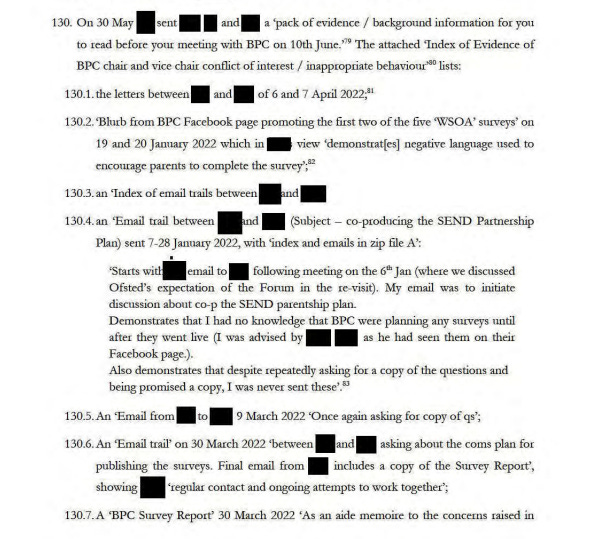
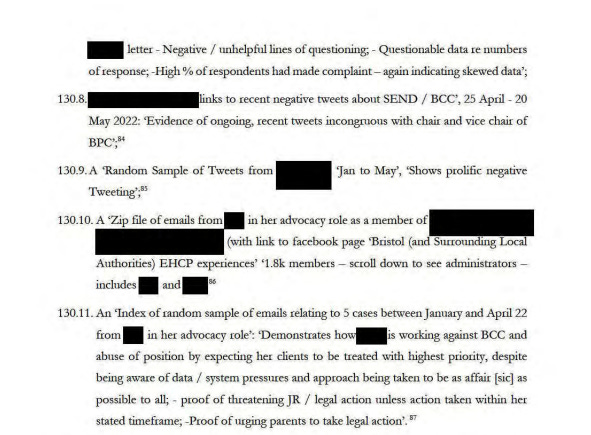
The product was a named document. Paragraph 130 records that on 30 May, a “pack of evidence / background information for you to read before your meeting with BPC on 10th June” was circulated internally. The attached file was titled “Index of Evidence of BPC chair and vice chair conflict of interest / inappropriate behaviour”. The vocabulary is the vocabulary of an investigation.
At paragraph 158, a witness describes the council’s social media monitoring as the institutional function it is. She had, she tells McColgan, “not been a part of the social media monitoring rota for many years now”. A rota. Staff take turns. The witness then offers two innocent explanations for why a particular parent’s tweet might have been flagged: it may have been the Covid keywords, or it “could also be the word ‘disabled’ because that is vulnerable group”. The investigator accepts the explanation at paragraph 159: BCC was not “monitoring individual people and actively searching them out”.
Whether the witness might have an interest in characterising the conduct as keyword-driven rather than person-targeted is not considered.
The most striking passage is at paragraph 163. A colleague describes the staff member the executive summary calls “enthusiastic” in language that is utterly different. The staff member did not have a “communications background” and “became a bit like a terrier”. She “wasn’t able to filter and sift through what was relevant and what wasn’t relevant”. She “didn’t understand what wasn’t a direct question, what was worth to be flagged”. As a result, “she just flagged everything”. The colleague adds: “I felt a little bit of empathy for her. A lot of the stuff she was looking at was very negative and I didn’t want her to feel like... it was going to get her down.”
A colleague is describing a member of staff who was, in her view, the wrong person doing the wrong work. The tweet that was being flagged in this passage, the tweet which “allegation 3” arose from, said: “found out this evening that one of my children is 6 years behind on their reading. I don’t know why I am hearing this now. But the outgoing number of complaints tomorrow is going to exceed my Personal Best...” The tweet did not tag the council. It was a mother’s public expression of grief about her disabled child’s reading age. The executive summary’s word for the staff member who flagged that tweet is “enthusiastic”. The body of the report describes someone who was, on her colleague’s own account, in the wrong job. The two characterisations do not meet.
The pattern of acceptance
A reader of the per-allegation findings will find a small set of phrases doing very consistent work. The conduct of BCC staff is repeatedly described as “entirely reasonable”, “entirely unremarkable”, “not inherently problematic”. Staff accounts of their own conduct are repeatedly accepted as “freely acknowledged”. Parents’ accounts of their experience are repeatedly tested against documents they cannot produce.
Four passages illustrate the pattern.
At paragraph 203, a member of BCC staff working in the Social Care Hub created a Twitter account in September 2021, followed Parent A, followed no one else, and subsequently deleted the account. McColgan finds “nothing inherently problematic” in a member of staff being interested in a prolific critic, and adds that the staff member would have used a fake name had her purpose been surveillance. The deletion is not addressed. The conflict of interest between the staff member’s role in delivering services to Parent A’s family and her interest in Parent A’s social media is not addressed.
At paragraph 206, McColgan acknowledges that an internal document referred to “three other top critical commenters” by name, but finds no further evidence was collected on them beyond their identification. That a council had compiled a named list categorising parents by their critical commentary is not, on that basis, treated as surveillance.
At paragraph 210, McColgan finds it “entirely reasonable” for BCC to “exhibit curiosity” as to the ownership of an anonymous Twitter account, in circumstances where the council’s relationship with parents was “fractured” and the parent carer forum had been, in her judgement, “ineffective”. The exercise of curiosity, in this instance, involved scrolling through approximately sixty photographs on a parent’s Facebook page. Both editorial judgements about the relationship and the forum are offered without analysis of cause. Both are used to justify the council’s investigation.
At paragraph 251, McColgan considers a complaint that a member of BCC staff joined a closed Facebook support group whose rules explicitly forbid council and school employees. Her investigation consists of asking BCC interviewees whether they recognised the name. None did. She concludes that it is “wholly unclear” whether the person was a member of BCC staff and applies the same formulation: he would have used a fake name had his purpose been surveillance. The complaint is dismissed on the basis of the council’s witnesses’ lack of recognition of one of its own potential employees.
The pattern is consistent. BCC’s witnesses are parties whose accounts are accepted, qualified only by a credulity test — would they have used a fake name? — that admits no examination of the actual evidence. The parents are parties whose claims are tested against documents they say the council did not send them, and which therefore cannot be produced.
How the report dismisses each instance
Across the per-allegation findings, the report’s reasoning follows a small set of recurring moves.
Public means not private. The report treats material posted on public platforms as carrying no reasonable expectation of privacy. The Home Office Code of Practice McColgan was applying is more careful. Paragraph 3.13 states that “there may be a reduced expectation of privacy for material accessible on the internet, but privacy considerations may still apply, for example, to information posted on social networking sites where the information may include or constitute private information. This is regardless of whether or not the account holder has applied any privacy settings.” Paragraph 3.10 says use of the internet does not normally engage privacy considerations, “but if the study of an individual’s online presence becomes persistent, or where material obtained from any check is to be extracted and recorded and may engage privacy considerations, RIPA authorisations may need to be considered.”
Persistence, and extraction and recording, are what the report documents.
Sporadic means not systematic. A staff member who “dips in and out” of a parent’s Twitter account as a habit is, on the report’s own account, conducting ongoing monitoring. That she did so unevenly is treated as relevant. The Code’s question is whether the activity, viewed cumulatively, was persistent, not whether it was efficient.
Topic monitoring is not person monitoring. Where named parents’ posts were flagged because they referred to SEND, the report treats this as monitoring of the subject matter rather than the individual. The distinction has surface plausibility for a generalist communications team. It is harder to sustain when the parents are named, when their posts are extracted and forwarded individually, when material on them is compiled into documents shared with their funder, and when officers in the directorate they are criticising are part of the email chain.
The forum role, not the parent role. The activities of Parents A and B are characterised as a “conflict of interest” with their roles within the Bristol Parent Carer Forum, justifying the council’s interest in their conduct. This is internally coherent but leaves out a fact the report does not engage with: a SEND parent on the forum is also a service user whose child’s provision depends on the same authority. McColgan finds that the parents’ activities were “irredeemably inconsistent with their roles in the BPCF”. The rest of the report does not back up this description with any specific finding or recommendation.
Legal surveillance is the only kind that counts. Throughout, the report answers the question “was this covert surveillance under RIPA?” rather than the broader question the parents and the Terms of Reference actually asked. When parents used the word “spying”, they meant being looked at, recorded and discussed without their knowledge by the council that runs their children’s services. The report tests that complaint against a statutory threshold designed for criminal investigations.
What the report itself accepts is surveillance
At paragraph 287.4, working through the RIPA framework, McColgan writes: “I do accept that the evidence gathering which took place on 8 October 2021... amounted to or involved ‘surveillance’”. She lists what the surveillance consisted of: the collection and collation of a list of comments on the council’s Facebook page; the collection and sharing of a tweet involving the exercise to determine the ownership of an anonymous Twitter account; and, possibly, the identification of Bristol Post articles and an online magazine.
This is the investigator’s express finding that what the council did on 8 October 2021 was, in the statutory language of RIPA, “monitoring... persons’ other activities or communications” — surveillance.
At paragraph 287.9 she goes further. The April-May 2022 evidence-gathering exercise on Parent A was, she finds, “conducted... over the period from 22 January to 3 May 2022”. A period of three months and ten days. The same paragraph reads: “I accept that, though sporadically undertaken, this may have amounted to surveillance for the purposes of RIPA.”
At paragraph 287.10 a third instance is accepted: the 20 May 2022 collation and forwarding of Parent A’s tweets “may have involved ‘surveillance’ for the purposes of RIPA.”
Three of the central acts of council monitoring that the parents complained about are, by the investigator’s own finding, surveillance within the meaning of the Act. What separates them from the conclusion at paragraph 288 — that no monitoring “amounted to or involved directed surveillance for the purposes of RIPA” — is the qualifier directed, which in the RIPA framework requires the surveillance to also be covert. The whole weight of the conclusion rests on the finding that surveillance of public material cannot be covert.
The way that finding is reached is worth setting out. The Home Office Code of Practice at paragraph 3.16 sets out nine factors public authorities should consider in establishing whether a directed surveillance authorisation is required. The factors include whether the investigation is directed towards an individual, whether it is likely to obtain private information, whether it involves building an intelligence picture, whether the information will be recorded and retained, whether it will provide a pattern of lifestyle, whether it is combined with other sources of information, whether it involves repeated viewing, and whether it identifies third parties. McColgan quotes all nine factors verbatim.
She then introduces her analysis with a single sentence: “Whether the monitoring of open source data has crossed the line from being ‘overt’ to ‘covert’ surveillance depends on the facts of the particular case.” The paragraphs that follow walk through each allegation in turn. The Code’s nine-factor test is not applied. Each factor would, on what the report itself accepts, point toward surveillance.
The activity was directed at named individuals. It involved obtaining private information, including material from a private Facebook page accessed by scrolling through approximately sixty profile photographs. It involved building an intelligence picture — the document circulated to staff was titled “Index of Evidence of BPC chair and vice chair conflict of interest / inappropriate behaviour”. It was recorded and retained, in the council’s own words, as “hard evidence”. It was sustained over months, including a three-and-a-half-month exercise on a single parent. It combined Twitter, Facebook, the Bristol Post, an online magazine, and the parents’ FOI requests. It involved repeated viewing, supported by what one BCC witness described as a “social media monitoring rota”. It identified third parties, including the three “top critical commenters” named alongside affiliated SEND groups.
None of the nine factors is worked through against the facts. They are quoted in the Code, recited, then replaced. In their place, a simpler binary test is applied: the material was public, therefore not covert. The test is not derived from the Code. The Code at paragraph 3.13 says precisely the opposite — that reduced privacy expectation on public material “does not... necessarily extinguish” privacy considerations. At paragraph 3.15, the Code says systematic collection and recording of information about a particular person should itself trigger consideration of authorisation. Neither qualification is engaged with.
There is a further difficulty in paragraph 287.4. McColgan records that the council’s purpose in the October 2021 evidence-gathering exercise was, in part, to identify whether Parent B was “the same [person] who was seeking to organise a Judicial Review application against BCC”. A council identifying the person behind anticipated legal action against itself is engaged in identifying a potential litigant, not in communications monitoring. The finding sits in the report’s own legal section, attributed to the council’s own purpose. The fact of the purpose, on the report’s own account, was one of the reasons the surveillance was undertaken.
Read in full, the legal section does not establish that no surveillance took place. It establishes that surveillance did take place — three times, by the investigator’s own finding. Every published factor the Home Office instructs public authorities to consider before undertaking such surveillance was met. Some of it was conducted to identify the person behind an anticipated legal challenge to the council. And none of it required authorisation, on the investigator’s reasoning, because the material collected was public. The executive summary describes the same picture as “no widespread or systematic surveillance” and recommends that future evidence-gathering exercises be considered against the RIPA test that the legal section has, by McColgan’s own admission, found three times was met.
Two passages, two registers
The clearest example of the report’s framing sits in two passages on facing pages of the body.
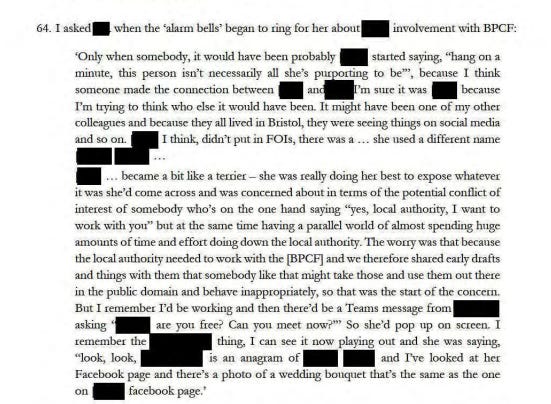
In the first, a BCC colleague describes a staff member who was, in 2021 and 2022, pursuing the identification of Parent B. The colleague characterises the staff member as having “became a bit like a terrier”, as “really doing her best to expose whatever it was she’d come across”, and as spending “huge amounts of time and effort” on the parents’ activities. The colleague recalls being interrupted at work by Teams messages: “are you free? Can you meet now?” The staff member would arrive on screen: “look, look, [name] is an anagram of [name] and I’ve looked at her Facebook page and there’s a photo of a wedding bouquet that’s the same as the one on [the parent’s] page.” McColgan’s executive-summary description of this same staff member’s work, at paragraph 21, is that she had “an enthusiastic approach to her job”.
In the second passage, at paragraph 32 of the body, Parent B describes the moment in 2022 when her son lost the 1:1 support specified in Section F of his EHCP. The information reached her at the school where she was a governor, second-hand, through a new SENCO who said the council had been in touch and would not be funding the support for Year 5. No reason had been given. Parent B wrote to BCC asking for the rationale. BCC did not reply. Parent B’s own words to McColgan, recorded in the same paragraph: “really hard to know, like was this just a bad decision because the system is a bit rubbish or was this a bad decision because it’s me?”
McColgan asked Parent B for her correspondence with BCC, and for details of an LGO complaint Parent B said had been upheld about a subsequent change of school. Parent B did not produce them. Complaint 11 — that her son’s services had been improperly reduced — was found at paragraph 44 to be “not well founded”.
A staff member pursuing a parent through Facebook photographs, anagrams of her name, and unscheduled Teams calls is described in the executive summary as enthusiastic. A mother describing the withdrawal of her son’s statutory support without explanation is required to produce the documents she has just said the council did not send her. Her complaint fails when she cannot. The condition of monitored dependency is that the harm is unprovable because the cause is undisclosed. Parent B says it herself: she cannot know whether her son’s funding was cut because she was being monitored, or because the SEND system is failing all children. Neither, on the evidence the report records, can the report. The complaint is dismissed because she cannot resolve a question the asymmetry of information makes unresolvable.
The “day or two” figure
The report’s most concrete cumulative finding is at paragraph 51. McColgan was satisfied, she writes, that staff time spent on anything “that might be regarded as social media monitoring” was “minimal, probably no more than [a] day or two”. It is the only quantitative figure in the conclusions, and the line most likely to be repeated.
It is calculated after three categories have been excluded. The “day or two” is the residual once McColgan has set aside subject-based monitoring by the Comms team, routine engagement with the council’s own Local Offer Facebook page, and routine engagement with tweets tagging the council. Those three exclusions cover most of what the report documents.
Even leaving the carve-outs in place, the residual described in the body is not consistent with a day or two of staff time. The report records: a five-week period across which a Comms officer forwarded at least five of Parent A’s tweets; the identification of Parent B by scrolling through some sixty photographs on her Facebook page; a screenshot of one of her tweets taken 23 minutes after posting; a staff member’s own written statement that Parent A’s posts were “regularly flagged” to her and that her account was the one she “regularly monitored”; two formal evidence-gathering exercises six months apart; a list of “top critical commenters” naming three further parents alongside three affiliated SEND campaign groups; a list of comments by named parents on the council’s Facebook page; the preparation and external dispatch of an evidence package to the BPCF’s funder; and a staff member’s own account of dipping into a parent’s Twitter as a “habit” and a “routine”. The conduct under investigation spans, in the Terms of Reference, eleven months.
It is open to McColgan to find this activity was reasonable. Many investigators might. What is harder to follow is the route by which an investigation documenting name lists, dossiers, six-month gaps between formal exercises, real-time capture, and cross-platform identification work arrives at a headline figure of a day or two. The figure is what is left after the work has been excluded.
What the Terms of Reference asked, and what they got
The Terms of Reference set McColgan four questions:
Evidence of what activity took place.
Whether such activity was an appropriate use of Council time, equipment, and resources.
Whether it was authorised through proper channels and consistent with policy and law.
The impact of such activity, including any consequences for the Parent Carer Forum’s independence and functioning, and for individual parents and families.
The conclusions address the first question at length, the fourth in part (with the qualified finding that the evidence gathering “may well have impacted” the funding decision), and the second only obliquely. The third — whether the activity was authorised through proper channels and consistent with policy and law — is not directly answered. The report finds no RIPA authorisation was sought because none was required. It does not find that the conduct was authorised. It finds that it did not need to be.
Since the Protection of Freedoms Act 2012, a local authority cannot in fact authorise RIPA-directed surveillance for the kind of conduct the report describes. Sections 37 and 38 require magistrate approval and apply a “serious crime” test: directed surveillance can only be authorised in respect of criminal offences carrying six months’ custody or more. The Bristol monitoring concerned no alleged criminal offence. Even if McColgan had concluded this was directed surveillance, BCC could not lawfully have authorised it. The relevant question becomes: under what governance regime did officers think they were operating when they collected, retained and circulated parents’ social media material?
The case the report does not mention
In 2010 the Investigatory Powers Tribunal handed down its first open ruling on a local authority’s use of RIPA, in Paton v Poole Borough Council. Poole had placed a family under three weeks of covert surveillance, including children aged between three and ten, to test the family’s claim about which address they lived at for school admissions purposes. The Tribunal found the authorisation unlawful. The council’s purpose was not proportionate. Alternative means had not been considered. The surveillance breached the family’s Article 8 rights.
The facts are different from Bristol’s. The principle is not. A local authority’s institutional interest in establishing facts about families it has dealings with — including parents whose children’s provision it controls — does not automatically justify the means it uses. Public concern about councils’ use of surveillance powers against families is part of why the 2012 reforms exist.
The information that no longer exists
McColgan’s second recommendation is the one with the most practical consequence. Bristol City Council deletes the email accounts of staff when they leave. She records that this “made my investigation more difficult”, that it created “significant information gaps”, and that it is “particularly problematic given BCC’s nature as a public authority”. Her recommendation is procedural: that staff be encouraged to keep personal correspondence in an identifiable folder which can be deleted on departure while retaining work-related matters for a suitable period afterwards.
What the report does not ask is why a public authority would routinely operate the practice in the first place. A council holds records that, if retained, could be the subject of Subject Access Requests, of Freedom of Information requests, of independent investigations like this one, and of regulatory or legal proceedings. Routine deletion at the point of departure has the practical effect of foreclosing all of those routes once the relevant member of staff has moved on. The report does not consider whether the practice could itself have any institutional function. It treats it as housekeeping.
An investigation commissioned in late 2025 into officer conduct between September 2021 and August 2022 was working with whatever records had survived more than three years of staff turnover. McColgan’s finding that no SEND services were withdrawn as a consequence of the monitoring is, necessarily, a finding made on the records that survived. We do not know what was in the ones that did not.
The recommendation sits inside a section of the report otherwise dedicated to the wellbeing of staff. Paragraph 54 turns to “the heavy toll imposed on former and current BCC staff” and recommends that the council protect them. The deleted-emails recommendation, in that context, reads less as a transparency reform than as a practical concern about leaving institutional documentation that might be discoverable later. The records-keeping change is in the same passage as the recommendation to shield staff from public criticism. Whether that proximity is intended or accidental is impossible to tell from the text. No equivalent records-keeping reform is recommended in the parents’ interest.
Who the investigator was moved by
The investigator's two moments of personal sympathy, the only points at which she writes about being moved by something she found, are both for the council's staff.
At paragraph 54, McColgan writes that she was “struck over the course of my investigation by the heavy toll imposed on former and current BCC staff by the toxic nature of social media commentary on education in Bristol”. She came across vitriolic material targeted at named individuals. She recommends that BCC “takes all reasonable steps to protect current and former staff from the vitriol” she anticipates will follow publication.
The observation is not, in itself, unreasonable. Council officers in a service as fraught as SEND are exposed to public anger that is sometimes sharp, sometimes personal, and sometimes — by ordinary standards — abusive. It is fair to record this. It is fair to ask the council to take it seriously.
At paragraph 168, the same phrase appears a second time. McColgan writes that she was “particularly struck” by a staff witness’s evidence of online vilification of council officers. The two moments of personal sympathy in a report of more than a hundred pages are both reserved for the council’s staff.
Paragraph 168 is also where the report’s reasoning aligns most explicitly with the council’s view. It opens by quoting the grant agreement between BCC, Contact and the BPCF, which provides that funding may be withdrawn if any forum member takes actions which “bring... the Funders’ name or reputation into disrepute”. BCC is one of those funders. The agreement gave the council a contractual right to defund the parent carer forum that exists to represent parents to the council, if those parents criticised the council too forcefully. McColgan quotes the clause as a neutral fact. She does not consider whether a clause of that kind is itself a problem.
She then offers what is perhaps the report’s most consequential finding. Against what she accepts was “routine and significant public vilification” of named SEND officers, she finds it “entirely unremarkable” that BCC staff took the view that “aggressive and persistent campaigning” against the council was inconsistent with a leadership role on the forum. “Entirely unremarkable” is applied to a sequence of decisions — the initiation of monitoring, the compilation of named-individual dossiers, the external sharing of evidence with the BPCF’s funder, the subsequent withdrawal of funding support — that any reasonable observer might regard as the most consequential thing the council had done to the parents in question. The decisions are not assessed against any test of proportionality, necessity, or alternative means. They are assessed against the question of whether council staff might reasonably have considered the campaigning a problem. The answer is yes. The investigator finds this entirely unremarkable.
A staff witness is then quoted at length on the parents’ state of mind. The witness describes BCC officers as having “our own personal experiences” of children with needs, but characterises the parents as having gone beyond this into “personal vendetta”, as appearing “to lose the plot”, as becoming “so personal and so full of hatred”, and as wanting to “infiltrate and take over” the forum. A staff member’s psychological assessment of two named mothers, offered to the investigator and reproduced without comment, qualification, or counterweight. No parent is quoted at comparable length on what they thought might be motivating the council’s interest in them.
“Vilification” is the operative word. The witness’s testimony is given weight because the investigator accepts that public criticism of named officers had become routine and significant. That may well be true. But “vilification” admits no analysis of cause. SEND parents in Bristol were operating in a service the council itself acknowledges has been failing for years — a Dedicated Schools Grant deficit of £85 million, an EHCP backlog described in the council’s own update report at the same June meeting, a Local Area SEND Reform Plan submitted under DfE deadline in the same month as this report’s publication. Public criticism of the SEND service did not arise from a void. The investigator’s framing of it as vilification, accepted from a staff witness without examination of cause, does what the rest of the report does in miniature: it treats the mothers’ anger as the problem to be explained, and the council’s response to that anger as the conduct to be understood sympathetically.
The three recommendations follow from this framing. Staff: to be protected. Staff records: to be better retained. Future evidence-gathering: to be subjected to procedural improvement.
The mothers are the subject of no recommendation. They are not asked after.
The mothers, and the authority their children depend on
The four parents whose complaints McColgan investigated are all mothers. Parents A, B, and C are each referred to throughout the report as the mother of a disabled son. Parent D appears with Parent C in the same affiliated-groups document. The further parents named on the council’s internal “top critical commenters” list are part of the same Bristol SEND parent network, a network whose advocacy work, in line with the well-documented pattern across SEND services nationally, is carried overwhelmingly by mothers.
The relationship between a SEND parent and the local authority is not a relationship between equals. It is a relationship of dependency that runs for the length of a childhood and, for some, into adulthood. The council writes the EHCP. It names the school. It funds the placement and the support hours within it. It holds the budget for the Disabled Children’s Service that was, in the period under investigation, at the centre of the parents’ complaints. A parent who criticises that authority publicly does so knowing the people responsible for her child’s provision will read what she has said. She cannot exit the relationship. She can only continue inside it.
The academic literature on SEND describes this asymmetry as a defining feature of the system. Local authorities hold procedural authority, resources and institutional knowledge while parents face complexity and limited influence (Riddell, et. al., Cambridge Journal of Education, 2010). Where dispute-resolution mechanisms are used, imbalance between an institutional party and a dependent one shapes the fairness of outcomes (Mastrofski, Sociological Practice, 1992). The repeated need to push for assessments and support, and the harm this struggle does to family wellbeing, is recorded across qualitative studies (Starkie, Journal of Research in Special Educational Needs; Cullen and Lindsay, Frontiers in Education, 2019). Deficit framings of parents in EHCP documentation, and limited engagement of children and young people in planning processes, are documented in recent qualitative research (University of East London, 2025).
The mothers whose social media was monitored by Bristol City Council were doing what the literature shows the system produces: fighting, in public, for their children.
McColgan finds that the parents’ campaigning activities were “irredeemably inconsistent” with their roles in the Bristol Parent Carer Forum, and that the council was entitled to gather evidence on them because of this conflict. The framing treats the parents as if they were professional officeholders engaged in a workplace conflict-of-interest dispute. They were mothers of disabled children who had taken on the work of representing other SEND families because that work needed doing, who continued to criticise the council’s SEND service when it failed their children, and who did so against the certain knowledge that the same council held everything their children depended on. The “conflict of interest” framing is the moral content of SEND advocacy described as a procedural problem.
The work of council SEND officers is not easy. Recent research on SEND assessment teams in England describes high workloads, unclear roles and instances of abusive interactions experienced by officers (Laverick and Baron, British Journal of Special Education, 2024). The report’s concern for the toll on staff is based on real experience that the academic literature confirms. The argument here is not that staff experience does not matter. It is that the report’s first-person mention of being “struck” is the only first-person usage in the document, and that the mothers — whose dependency relationship is documented in a literature the report does not engage with — receive no equivalent acknowledgement, no equivalent recommendation, and no equivalent compassion.
The language Parent B records being used against her in meetings — being called “hysterical”, “blowing things out of proportion”, “untrustworthy” — appears in the report at paragraph 13 as testimony, and is not analysed. It is well-worn language for dismissing women raising concerns about institutions that hold power over their lives. The report’s conclusions do not consider what it might mean that the council, in the same period, was scrolling through one of those women’s Facebook photographs to identify her as the holder of an anonymous account, and was preparing evidence on her to be shared externally with her own forum’s funder.
A power imbalance of this kind is not a trivial factor. It is the reason “publicly available” cannot mean the same thing when the subject of the watching is a mother whose child’s future depends on the watcher. A council’s institutional interest in managing its critics and a mother’s right to speak about her child’s care are not symmetrical interests. The report’s silence on that asymmetry is the most important thing it does not say.
The questions that remain
Read narrowly, this is a report that exonerates Bristol City Council. Read in full, it is an investigation that documents a council doing things it had no obvious framework to do, finds no governance failure because none of the established frameworks for surveillance technically apply, accepts in its own legal analysis that surveillance took place on three separate occasions, and stops short of answering the question its Terms of Reference put to it about whether the conduct was authorised through proper channels.
The committee meeting on 25 June will be asked to note the findings. Whether that is sufficient depends on whether members are satisfied with the answers given to questions they themselves commissioned.
A short list of what remains unanswered:
What policy now governs the viewing, screenshotting, extraction, retention and internal circulation of identifiable parents’ social media posts by council staff?
Who within the council has authority to commission the kind of evidence-gathering exercise McColgan describes, and against what tests of necessity and proportionality?
The report at paragraph 287.4 records that one of the purposes of the October 2021 evidence-gathering exercise was to identify whether Parent B was the person seeking to organise a Judicial Review application against BCC. Will the council confirm whether identifying potential litigants against itself is a routine purpose of its social media evidence-gathering, and against what framework of legal advice this purpose was pursued?
The report at paragraph 158 records the existence of a “social media monitoring rota” inside the council. What is the current status of that rota, who is on it, what is its written purpose, and against what tests of necessity and proportionality does it operate?
The grant agreement between BCC, Contact and the BPCF includes a clause permitting funding withdrawal if forum members take actions that bring the funders’ reputation into disrepute. Does the council consider it appropriate that an organisation funded by/through the council to represent parents to it should be subject to contractual reputational protection for the council? Will this clause be renegotiated as part of any future funding agreement?
Given the report’s own finding at paragraphs 287.4, 287.9 and 287.10 that three of the council’s evidence-gathering activities did involve “surveillance” within the meaning of RIPA, will the council adopt a written policy on social media evidence-gathering in advance of any further conduct of this kind?
What is the council’s response to Parent B’s account that the loss of funding led to two BPCF redundancies, and to McColgan’s qualified finding that the evidence gathering may have contributed to that decision?
By what date will Bristol City Council change its leavers practice on staff email accounts, and who is responsible for the change?
The report’s only first-person expression of sympathy is reserved for council staff. Will the committee ask officers to explain what acknowledgement, if any, the council intends to offer to the mothers whose social media was the subject of the evidence-gathering this report documents?
McColgan ends her report with a careful note that publication may be a difficult and emotive time for those involved, and that the council should protect current and former staff from the abuse she anticipates will follow. Both points are reasonable.
The protection that current and former parents have from the conduct her own report documents is a question the report itself does not address.
References to the academic literature on power asymmetries in SEND, drawn on in the section on mothers and dependency: Riddell, S. and Weedon, E. (2010), “Reforming special education in Scotland: tensions between discourses of professionalism and rights”, Cambridge Journal of Education 40(2). Mastrofski, J.A. (1992), “Power Imbalance within the Setting of Special Education Mediation”, Sociological Practice 10(1). Cullen, M.A. and Lindsay, G. (2019), “Special educational needs: understanding drivers of complaints and disagreements in the English system”, Frontiers in Education 4. Starkie, Z., “Parental experiences of accessing assessments for special educational needs”, Journal of Research in Special Educational Needs. University of East London (2025), “Parents, Power and Partnership: A Qualitative Study of Family Experiences of the Education, Health and Care Plan Process”. Laverick and Baron (2024), “Understanding Special Educational Needs and Disabilities Assessment and Review Team experiences”, British Journal of Special Education.
Phenomenal and dedicated work, Joanna.
As usual, it is the power balance in such council matters that seems to get forgotten. Having your social media accounts watched by 'the authorities' feels very much like surveillance, however it is technically defined with words like covert vs overt etc. And the impression is given that if you are suffering from council policy and voice your criticism, you will be treated as a problem. Involving staff who are there to earn a living and keen to please creates a really difficult situation, to put it mildly.